
How the Market Market was Born in 2009?
Crypto Origins – Bitcoin (2009)
🌐 Background
In 2008, there was a big financial crisis. Many people lost trust in banks and governments.
At that time, a secret person (or group) named Satoshi Nakamoto had a new idea:
“A digital money that works without banks.”
Bitcoin Whitepaper
- In October 2008, Satoshi published a paper called:
“Bitcoin: A Peer-to-Peer Electronic Cash System.”- It explained how people can send money directly using blockchain, without a bank.
First Block – 3 January 2009
- On this day, Satoshi created the first Bitcoin block, called the Genesis Block.
- Inside it, he wrote a hidden message: “The Times 03/Jan/2009 Chancellor on brink of second bailout for banks.”
- It was a sign that Bitcoin was born as an answer to broken banks.
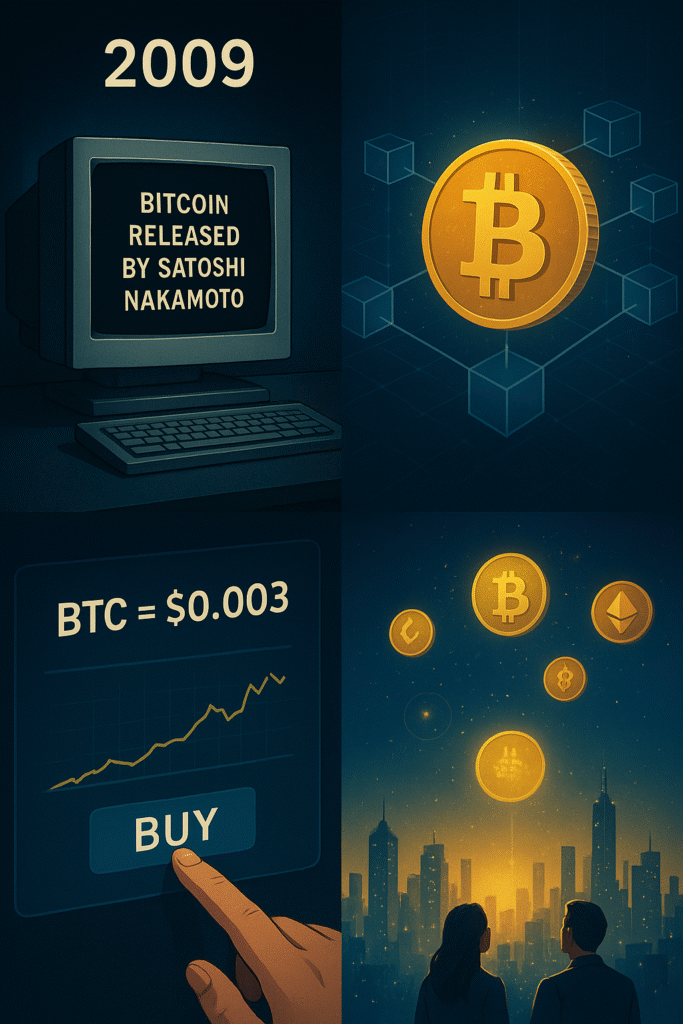
People say crypto was “born in 2009” because that’s when the very first cryptocurrency, Bitcoin, was officially launched.
Here’s why 2009 is marked as the birth year:
- Bitcoin Network Launch –
- On January 3, 2009, the mysterious creator of Bitcoin, known as Satoshi Nakamoto, mined the first block of the Bitcoin blockchain.
- This first block is called the “Genesis Block” or Block 0.
- First Real Blockchain –
- While ideas about digital money existed earlier, Bitcoin was the first to combine blockchain technology, cryptography, and decentralization into a working system.
- Start of the Crypto Market –
- Before 2009, there were no real cryptocurrencies being traded. After Bitcoin’s launch, the concept spread, leading to thousands of cryptos today.
So, people say crypto was born in 2009 because that’s the year the world’s first cryptocurrency (Bitcoin) came into existence and the entire crypto industry started
Crypto Birth Timeline
📌 2008 (October 31)
- A person (or group) under the name Satoshi Nakamoto published the Bitcoin whitepaper:
“Bitcoin: A Peer-to-Peer Electronic Cash System.” - This explained how a decentralized digital currency could work without banks.
📌 2009 (January 3)
- Satoshi mined the Genesis Block (Block 0).
- This marked the birth of Bitcoin and the first-ever cryptocurrency transaction system.
- Message inside the block: “The Times 03/Jan/2009 Chancellor on brink of second bailout for banks” — a statement about financial crisis.
📌 2009 (January 12)
- The first Bitcoin transaction happened.
- Satoshi Nakamoto sent 10 BTC to Hal Finney (a programmer and early Bitcoin supporter).
📌 2010 (May 22)
- The first real-world purchase using Bitcoin took place.
- A programmer named Laszlo Hanyecz paid 10,000 BTC for two pizzas.
- This day is now celebrated as Bitcoin Pizza Day 🍕.
✅ That’s why people say crypto was born in 2009 — it’s when Bitcoin officially came alive and the crypto world began.

Why Bitcoin Price Was Near Zero in 2009
- No Value Yet –
- In 2009, Bitcoin was brand new.
- No one trusted it, no shops accepted it, and only a handful of tech people knew about it.
- No Market –
- There were no exchanges to buy/sell Bitcoin.
- People only mined it for fun or testing.
- Abundant Supply –
- It was easy to mine Bitcoin in the beginning (using a normal computer).
- So, supply was high but demand was very low → price stayed near $0.
🔹 Why Bitcoin Became Very Expensive by 2025
- Limited Supply –
- Only 21 million Bitcoins will ever exist.
- As more people wanted Bitcoin, but supply stayed fixed → price went up.
- High Demand –
- Millions of people, investors, and even companies now buy Bitcoin.
- Many see it as “digital gold” and a safe way to store money.
- Adoption –
- More businesses, apps, and countries (like El Salvador) started accepting Bitcoin.
- This gave Bitcoin real-world use and credibility.
- Scarcity Over Time –
- Every 4 years, Bitcoin has a halving (block rewards cut in half).
- This makes new Bitcoins rarer → drives price higher.
- Global Trust & Hype –
- Media, big investors, and even governments now talk about Bitcoin.
- This builds trust, and more people buy → pushing the price even higher.
✅ In short:
- 2009: Nobody cared, price ≈ $0.
- 2025: Millions of people care, demand is huge, supply is limited → price skyrocketed.
In 2009, Bitcoin had almost no value because it was brand new, unknown, and used only by a few tech enthusiasts. There were no exchanges, no real demand, and mining was easy, so the supply was high but nobody wanted it. That’s why its price was close to zero. By 2025, things changed completely — Bitcoin became globally recognized as a store of value, often called “digital gold.” Its supply is limited to 21 million coins, and every four years the mining reward halves, making it even scarcer. At the same time, millions of people, companies, and even some governments started adopting and investing in it. This combination of limited supply, rising demand, adoption, and global trust caused Bitcoin’s price to skyrocket from almost nothing in 2009 to tens of thousands of dollars in 2025.
Bitcoin was launched mainly as a response to the 2008 global financial crisis and to solve the problems of the traditional banking system.
Here are the main reasons why Bitcoin was created:
- Distrust in Banks and Governments 🏦
- In 2008, banks collapsed and governments bailed them out with taxpayer money.
- Many people lost trust in the financial system.
- Bitcoin was designed to be independent of banks and governments.
- Decentralization 🌍
- Traditional money is controlled by central banks.
- Bitcoin was made to run on a peer-to-peer network where no single authority is in charge.
- Limited Supply (No Inflation) 💰
- Governments can print unlimited money, which causes inflation.
- Bitcoin has a fixed supply of 21 million coins, making it scarce like gold.
- Transparency & Security 🔐
- Bitcoin transactions are recorded on a public blockchain, making them open and secure.
- Unlike banks, no one can secretly change the records.
- Global Digital Money 🌐
- Bitcoin was created as a form of borderless digital cash.
- Anyone with internet access can use it, without needing a bank account.
Current State of the Bitcoin Network

- Hash Rate & Difficulty
- The global hash rate (i.e. computational power securing the network) is extremely high — on the order of Zetta-Hashes per second (ZH/s). CoinWarz
- Mining difficulty adjusts roughly every 2,016 blocks (~two weeks) to keep block times near ~10 minutes. CoinWarz+1
- Block Height & Supply
- Bitcoin’s blockchain is far along: block height is above 914,000 blocks. Bitbo+1
- Circulating supply is about 19.9 million BTC (out of a maximum 21 million). Bitbo+2Investopedia+2
- Network Uptime & Stability
- Transactions & Fees
- Segregated Witness (SegWit), Taproot, Upgrades
- Some protocol upgrades like Taproot (in 2021) have improved privacy, efficiency (signatures), and script flexibility. Investopedia
- Most transactions use SegWit format and many blocks contain high percentages of SegWit/Taproot transactions. Bitbo+1
- Layer-2 Solutions (Lightning Network)
- To address Bitcoin’s scalability and transaction speed, the Lightning Network is extensively used. It allows many small/frequent transactions off-chain, settling on-chain only when needed. Wikipedia+1
- Lightning transactions are much cheaper and faster. Wikipedia
- Security & Decentralization
- The network is still very decentralized in terms of nodes and miners, though mining pools concentrate mining power somewhat.
- It relies on proof-of-work, which ensures security via economic cost of mining. The high hash rate makes attacks extremely difficult. CoinWarz+1
⚠️ Challenges / Risks
- Energy Usage: Bitcoin’s proof-of-work mining consumes a lot of electricity, which raises environmental concerns.
- Scalability: On-chain transactions are slow and expensive during times of heavy demand. Layer-2 helps but comes with its own trade-offs (complexity, liquidity, usability).
- Regulation: Governments around the world are scrutinizing Bitcoin more (tax, legality of mining, exchanges, etc.).
- Fee Volatility: When network usage spikes, fees rise a lot, which can make small payments impractical.
- Protocol Upgrades Need Consensus: Changes to Bitcoin’s protocol are conservative; getting wide agreement is slow.
If you want, I can also pull up live metrics (hash rate, mempool size, current fees) so you see what Bitcoin network looks like right now.
Current State of the Bitcoin Network

- Hash Rate & Difficulty
- The global hash rate (i.e. computational power securing the network) is extremely high — on the order of Zetta-Hashes per second (ZH/s). CoinWarz
- Mining difficulty adjusts roughly every 2,016 blocks (~two weeks) to keep block times near ~10 minutes. CoinWarz+1
- Block Height & Supply
- Bitcoin’s blockchain is far along: block height is above 914,000 blocks. Bitbo+1
- Circulating supply is about 19.9 million BTC (out of a maximum 21 million). Bitbo+2Investopedia+2
- Network Uptime & Stability
- Transactions & Fees
- Segregated Witness (SegWit), Taproot, Upgrades
- Some protocol upgrades like Taproot (in 2021) have improved privacy, efficiency (signatures), and script flexibility. Investopedia
- Most transactions use SegWit format and many blocks contain high percentages of SegWit/Taproot transactions. Bitbo+1
- Layer-2 Solutions (Lightning Network)
- To address Bitcoin’s scalability and transaction speed, the Lightning Network is extensively used. It allows many small/frequent transactions off-chain, settling on-chain only when needed. Wikipedia+1
- Lightning transactions are much cheaper and faster. Wikipedia
- Security & Decentralization
- The network is still very decentralized in terms of nodes and miners, though mining pools concentrate mining power somewhat.
- It relies on proof-of-work, which ensures security via economic cost of mining. The high hash rate makes attacks extremely difficult. CoinWarz+1
⚠️ Challenges / Risks
- Energy Usage: Bitcoin’s proof-of-work mining consumes a lot of electricity, which raises environmental concerns.
- Scalability: On-chain transactions are slow and expensive during times of heavy demand. Layer-2 helps but comes with its own trade-offs (complexity, liquidity, usability).
- Regulation: Governments around the world are scrutinizing Bitcoin more (tax, legality of mining, exchanges, etc.).
- Fee Volatility: When network usage spikes, fees rise a lot, which can make small payments impractical.
- Protocol Upgrades Need Consensus: Changes to Bitcoin’s protocol are conservative; getting wide agreement is slow.
Here the link of: https://bilalblooger.com/nepal-protests-2025-social-media-ban-corruption-anger-and-political-crisis/
I don’t think the title of your article matches the content lol. Just kidding, mainly because I had some doubts after reading the article.
I don’t think the title of your article matches the content lol. Just kidding, mainly because I had some doubts after reading the article. https://www.binance.com/register?ref=IXBIAFVY